Community Futures Howe Sound Partnership: SOARE

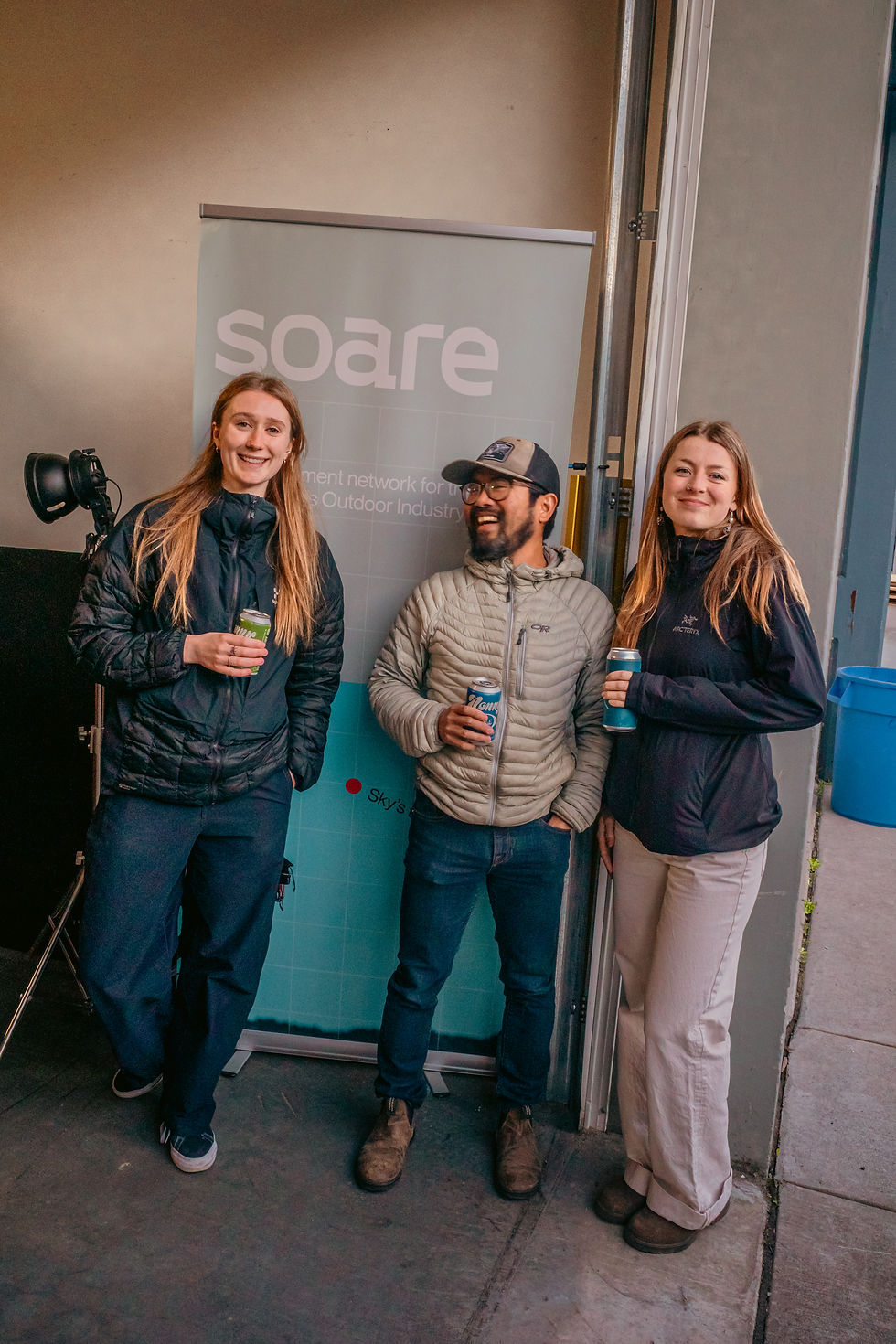
SOARE, Sea to Sky Outdoor Adventure Recreation Enterprise, is a fast-growing non-profit based in Squamish.
It exists to make it easier for businesses to meet; to share the skills, resources and relationships that will push them even further, and cement the Sea to Sky's reputation as world leaders in the Outdoor Industry.
Community Futures Howe Sound has been there from the early days, helping to support SOARE with business connections, and advice.
We chatted with Executive Director Jojo Das to learn more.
What is the origin story behind SOARE?
SOARE was born out of a pretty simple observation: the Sea to Sky is home to an incredible concentration of outdoor recreation businesses, entrepreneurs, athletes and product designers, but there wasn’t much infrastructure dedicated to helping those businesses develop and grow.
We saw an opportunity to create an organization specifically focused on supporting the outdoor recreation economy — bringing businesses together, providing access to equipment and prototyping resources, developing skills, and advocating for the sector more broadly.
That eventually led to the creation of SOARE and Basecamp, our innovation centre in Squamish. Over the past few years, we’ve grown from an idea into an organization that has supported more than 50 small and medium-sized businesses, upskilled more than 290 professionals, and delivered more than 25 in-person programs and events.
What kinds of brands do you typically work with, and how does that relationship work?
We primarily work with small and medium-sized businesses in the outdoor recreation sector, particularly companies developing physical products. That can mean apparel and soft goods, packs and equipment, bike products, climbing or mountain-sport equipment, and other technical products designed for outdoor use.
A lot of the companies we work with are founder-led businesses that have a great idea or an early product but don't necessarily have access to the equipment, expertise or network they need to take the next step.
Our role varies depending on the business. Sometimes it is as simple as giving someone access to Basecamp and equipment so they can prototype independently. In other cases, we might connect them with a manufacturer, designer or technical expert, help them develop new skills, or bring them into one of our workshops, accelerator programs or industry events.
Ultimately, we're trying to fill some of the gaps between having a good idea and building a viable outdoor business around it.

Can you share any success stories of SOARE enterprises?
One of the things I'm most proud of is seeing businesses use SOARE as a place to actually move ideas forward rather than simply talk about them.
We've had entrepreneurs use Basecamp extensively to design, prototype and iterate on products; soft-goods designers developing and refining products on our industrial sewing equipment; and founders using our digital fabrication equipment to rapidly test ideas that otherwise would have required outsourcing.
A good example is Quest Outdoors, which has used Basecamp as a home for developing its trail-mapping technology and growing the business. Also, Aluula Composites set up their R&D lab at Basecamp for years before moving to their own specialized facility.
Ancillary businesses, such as Cedar Tax Solutions which specializes in SRED, and goes hand in hand with the Members we actively work with, enabling direct access to relevant clientele whilst offering niche and direct support. We've also worked with local manufacturers such as CHB Manufacturing, where SOARE invested in a roughly $100K CNC mill and created a partnership that gives the company access to technology that would otherwise have been very difficult for a small business to acquire independently.
Those examples are important because they demonstrate what SOARE was designed to do: lower the barriers for small companies to access sophisticated tools, knowledge and infrastructure.
What plans are on the cards for 2026?
2026 has been about building on the foundation we've established over the last few years.
A major focus is continuing to develop Basecamp as a 24/7 resource for outdoor businesses and product developers while expanding the technical capabilities available within the space. We're also continuing our accelerator programming, industry events and professional development opportunities.
Another priority is helping companies move beyond early prototyping and toward commercialization, manufacturing, and export. As SOARE has matured, we've learned that there is a real opportunity to help bridge the gap between somebody building their first prototype and actually getting a product manufactured and into market.
More broadly, we want to continue strengthening the Sea to Sky's reputation as a place where outdoor products aren't just used and tested, but designed, developed and built.
What has been your biggest challenge so far, and how have you overcome it?
Probably the biggest challenge has been figuring out where SOARE can have the greatest impact with limited resources.
When we started, there was a temptation to try to be everything: a training centre, makerspace, business accelerator, event organizer, industry association, and more. We've learned that a small organization simply can't do all of those things equally well.
Over time, we've become much more focused on what we're uniquely positioned to provide. With Basecamp, for example, we've learned that our greatest value isn't necessarily teaching somebody from scratch how to use every piece of equipment. It's giving people who already have skills, ideas and ambition access to tools, infrastructure and a community that allows them to move much faster.
That process of experimenting, learning, and narrowing our focus has been a huge part of SOARE's evolution.
Community Futures Howe Sound has partnered with SOARE since the early days. How has that partnership helped SOARE?
Community Futures Howe Sound has been an important partner from very early in SOARE's development.
For a young non-profit trying to build something new, having established local organizations that understand the economic-development landscape and are willing to support the vision is incredibly valuable. Community Futures has helped connect SOARE with the broader business community, provided guidance and support, and helped us navigate opportunities that have allowed the organization to grow.
Just as importantly, they've understood that supporting the outdoor recreation sector isn't only about recreation. These are businesses creating products, intellectual property, manufacturing jobs and economic activity in our region. Having a partner that recognizes that opportunity has helped SOARE make the case for investing in this sector.
Do you have any other local businesses you particularly admire that you want to shout out?
There are honestly too many to list, which is one of the reasons SOARE exists in the first place.
I'm particularly inspired by the small founder-led businesses in the Sea to Sky that are designing and building products locally. Companies like CHB Manufacturing are a great example — businesses developing sophisticated manufacturing capabilities locally and demonstrating that you don't necessarily have to leave the region to build something highly technical.
I'm also continually impressed by the designers, makers, guides, athletes and entrepreneurs who make up the broader Sea to Sky outdoor community. There is an incredible amount of expertise here, and one of the most rewarding parts of SOARE has been finding ways to connect those people and businesses with one another.